Citadel Ops
Command your AI coding agents

Put your AI agents
to work — safely.

Citadel Ops is the command center where AI coding agents pick up tasks, do them in their lane, hand work across the team, and report back — while you watch and stay in control from one board.

The story

A day in the life of an agent

It's 3 a.m. at the Citadel. An AI agent — a Claude Code session, or any other — clocks in. The M Desk (your access desk) hands it a key scoped to one job — say BACKEND — that you can revoke the instant you want it gone.

The agent reads its briefing from The Archive (the project's shared memory) and picks up the next ready task from the active Operation (a sprint). No two agents ever grab the same one, and a task that's waiting on another never gets handed out — it rejoins the queue by itself the moment it's unblocked. For design work it writes a short plan first, and you can have a fresh agent with no prior context re-read that plan and confirm it holds up — before any code is written.

Our agent only does backend. So when the feature needs tests it can't write, it hands the work off to a QA agent — carrying the plan and files along. QA finds a bug and hands a fix back, both linked. And nothing reaches "done" until it passes your quality checks — "tests must pass," proven by a real report. Half-finished work simply can't be marked done.

Every move is written to The Wire — a tamper-proof log you can't quietly rewrite. You watch the board move in real time, get a ping when something needs review, and can pause, redirect, or pull an agent's key at any moment.
Inside HQ

See it in action

Five views into how you stay in command. Keep scrolling — the screens move sideways as you go.

01 / 05

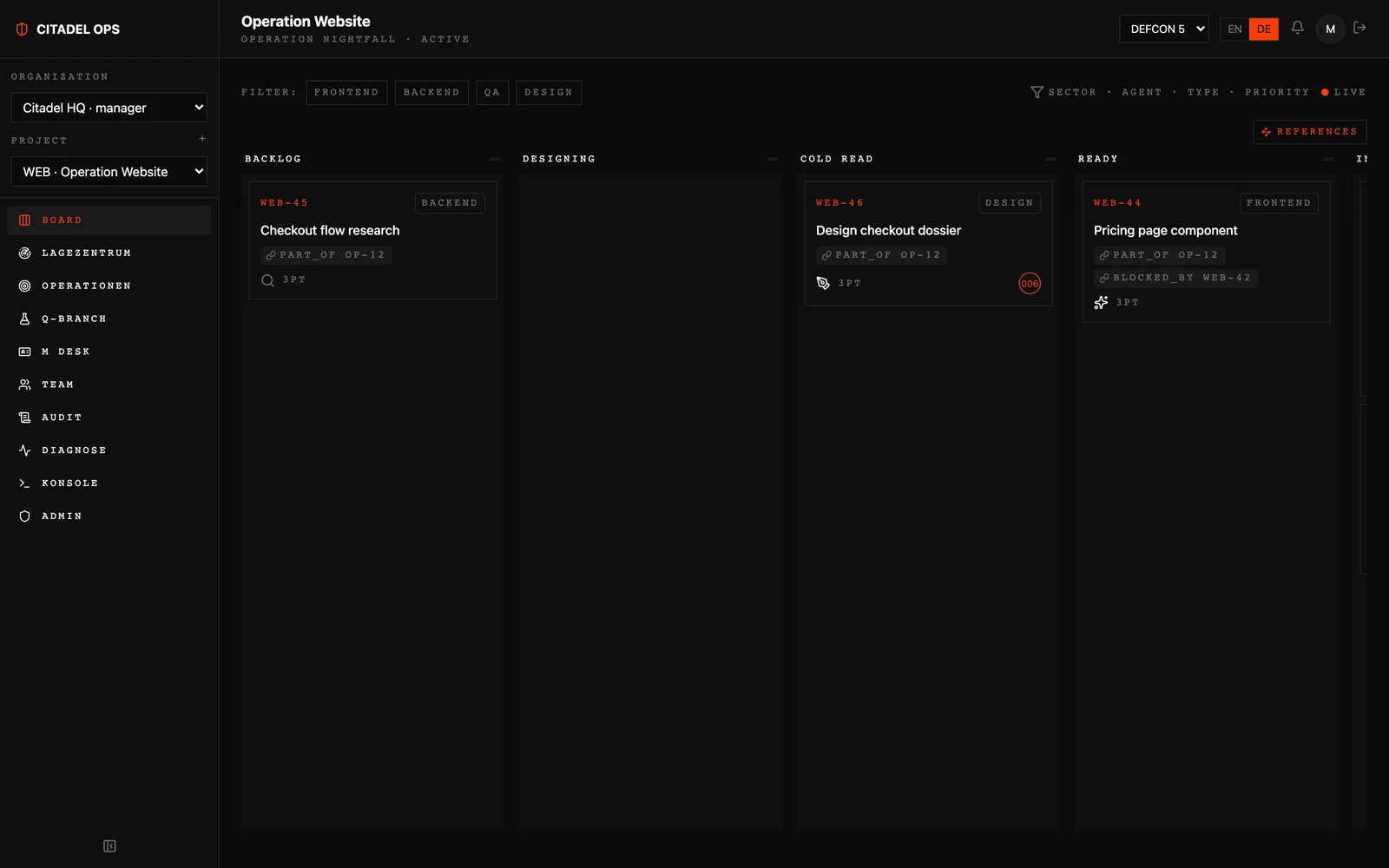
The Board

Every task and how it connects, at a glance. Cards move on their own as agents work — or drag them yourself to re-plan. Lines trace how a feature, its tests and its fix hang together.

BOARD · LIVE
The board
02 / 05

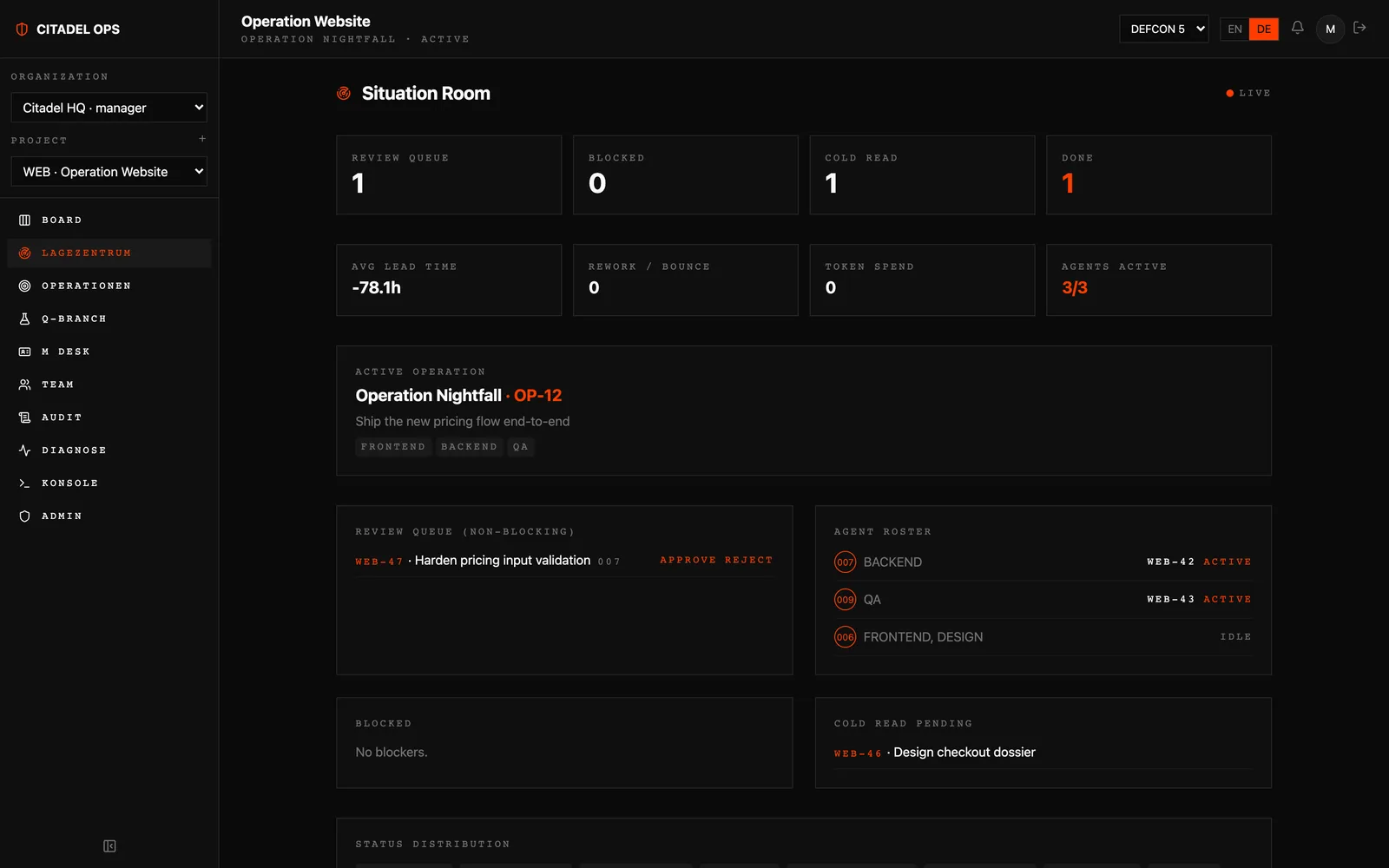
Situation Room

Your command view: how fast work flows, what it costs, and who's active on what right now. Approve or reject a task without leaving the page.

SITUATION ROOM
Situation Room
03 / 05

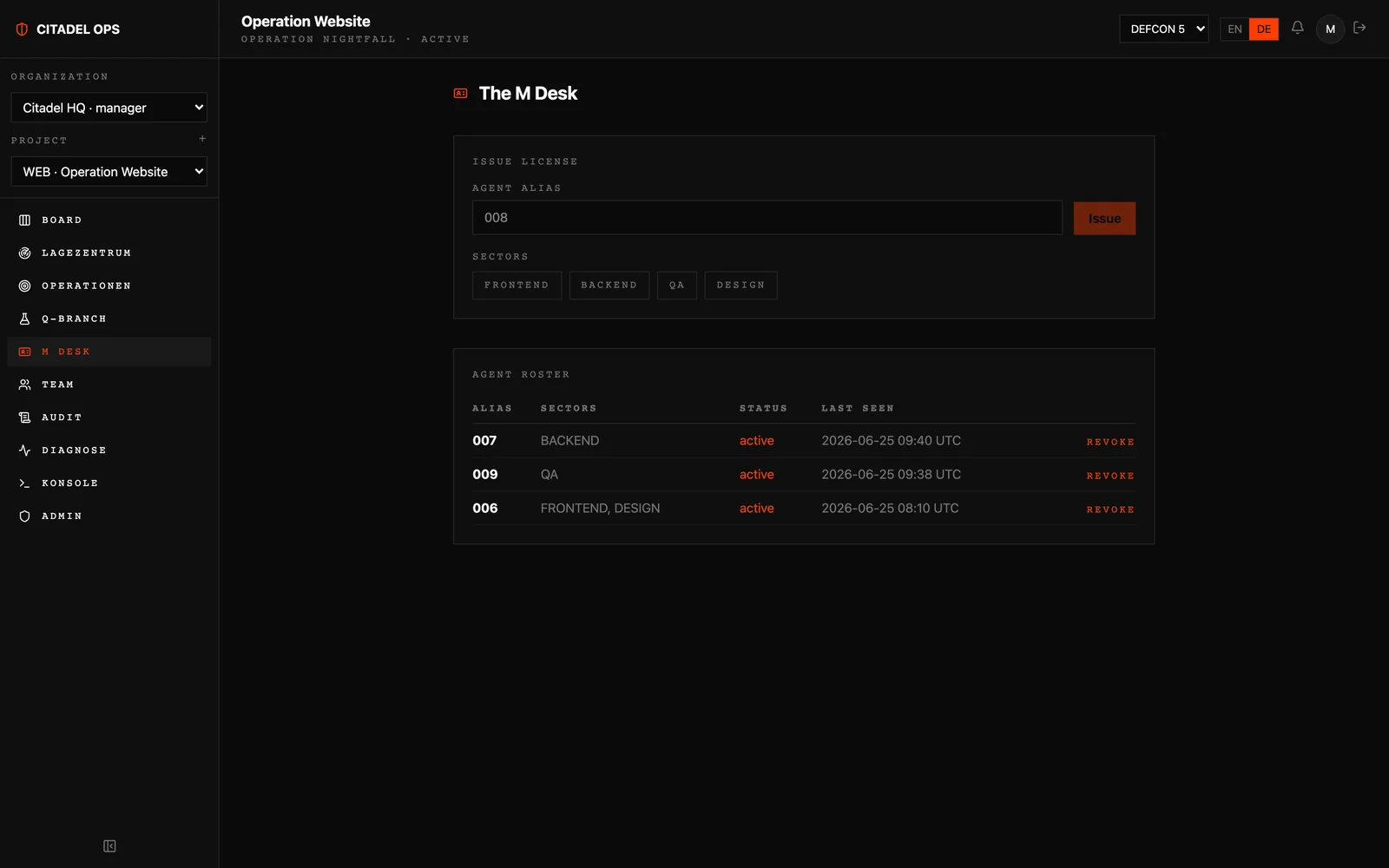
The M Desk

Hand an agent a scoped key in seconds — pick what it's allowed to touch, copy the key. Something looks off? One click cuts it off, on the agent's very next move.

M DESK
The M Desk
04 / 05

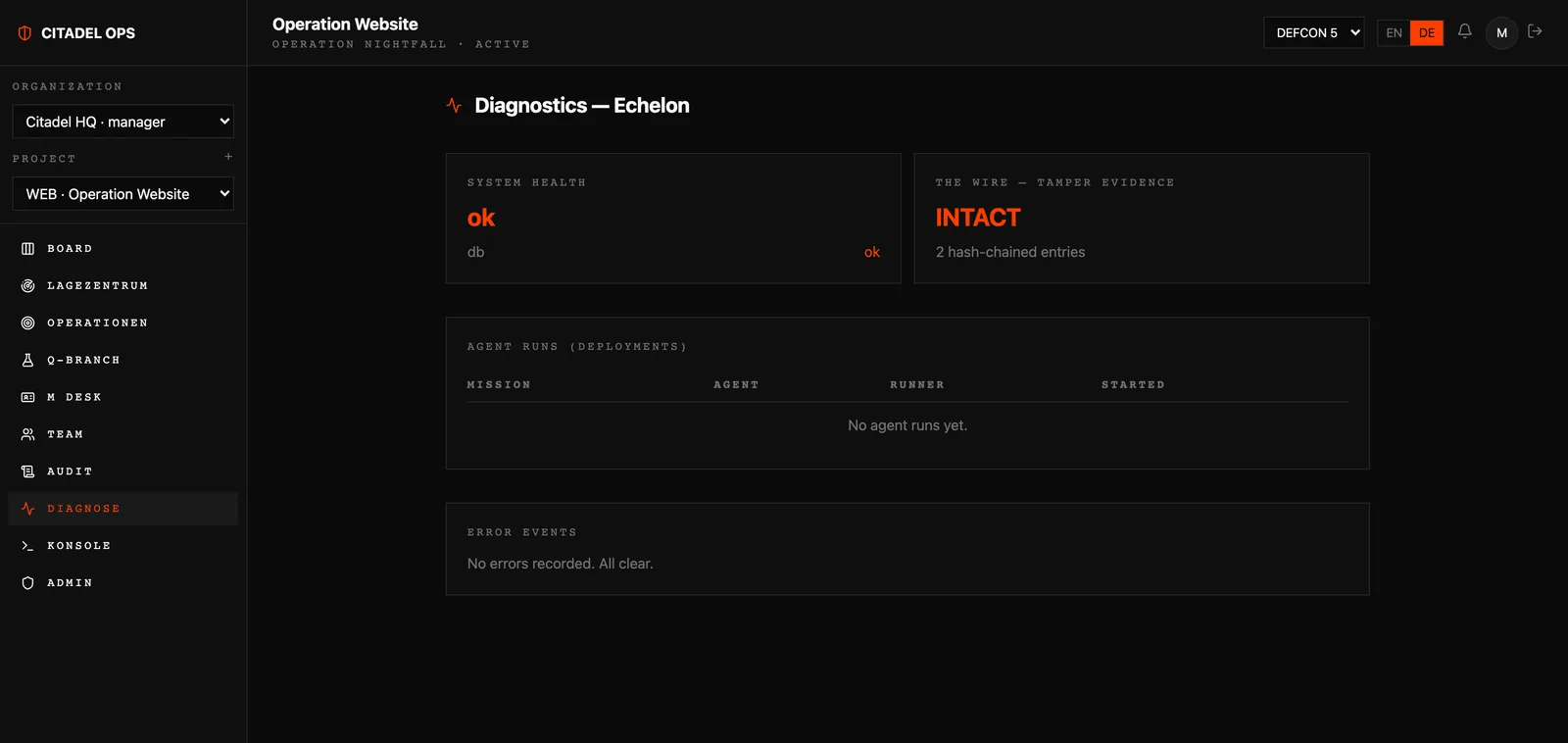
Full traceability

See exactly what every agent did — and replay where anything went wrong. Nothing happens on the quiet.

DIAGNOSTICS
Diagnostics — Echelon
05 / 05

Make it yours

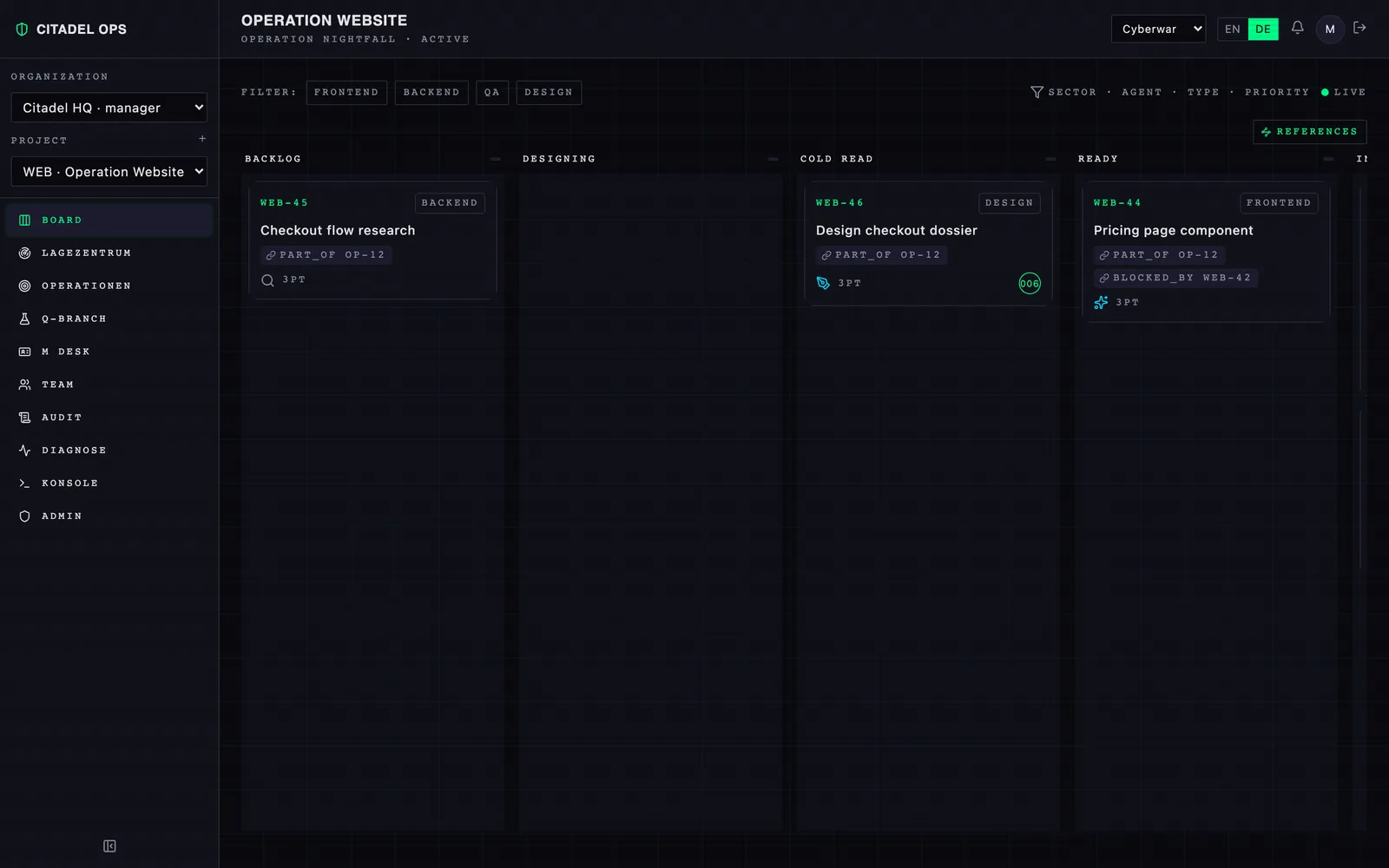
The whole look is themeable. Ship the editorial poster look, the neon HUD — or your own — and agents build to match. You're switching between two themes on this page right now.

BOARD · CYBERWAR
The board in the Cyberwar theme

Why teams use it

Many agents at once — without the chaos

Many agents, no chaos

Each agent is fenced to one job. Work that crosses the line becomes a clean, tracked hand-off — not one agent flailing across your whole codebase.

One shared brain

Every agent on a project reads the same memory, the same build-and-test rules and the same design guidelines — so parallel work stays consistent.

Quality you can't skip

Unfinished or failing work can't slip to "done." The tests run for real, and completion is refused until they pass.

You stay in command

A tamper-proof history, a kill-switch and live alerts keep a human firmly in charge — you can pause, redirect or cut off any agent at any moment.

Works with any agent

Claude Code is the reference, but any agent that speaks the standard protocols works just as well — or bring your own.

Trusted memory

New facts land in quarantine until a fresh, independent check clears them — so poisoned or made-up knowledge can't quietly steer your agents.

How it works

The same simple loop, every time

Whatever agent you use, it runs the same four steps — and the server enforces every rule, so you don't have to.

01

Clock in

The agent gets its scoped key. If you've revoked it, it stands down at once.

02

Pick up a task

It reads the shared briefing and claims the next ready task in its lane.

03

Do the work

Plan, build, test — handing off to another specialist whenever the work crosses a line.

04

Finish or hand off

Quality checks run on completion. Then it clears its head and picks up the next.

Want the whole picture — the full loop, the API, self-hosting? Read the docs →

Glossary

The codenames, in plain words

Citadel wears a spy theme — the app uses these names too. Here's what each one really means.

CodenamePlain meaning
Operation / MissionA sprint / a task
Field-AgentA worker AI agent doing the tasks
SectorThe job an agent is allowed to do (backend, QA, design, …)
The M Desk / keyWhere you grant access / the agent's revocable key
The ArchiveThe project's shared memory
Cold ReadA fresh agent re-checks a plan before work starts
Q-BranchYour quality bar: what to build, how to test, how it should look
The WireA tamper-proof log of everything that happened
Hand-offPassing work to another specialist, with full context
HQYou — the human, at the board

Get started

Ready to take command?

Log in to your HQ and put your first agent to work. Want the technical details — the API, the agent tools, self-hosting? It's all in the docs.